
Calaveras County Death Index
Calaveras County keeps death records for all deaths within the county. The Clerk-Recorder office in San Andreas issues certified copies to authorized requesters. Death certificates cost $26 per copy under California law. You can obtain these records in person, by mail, or through VitalChek online. The county maintains files for historical deaths as well as current registrations. Processing times vary from same day for walk in visits to several weeks for mail requests. California Health and Safety Code Section 103526 defines who qualifies to receive authorized certified copies versus informational copies. The office serves families, legal representatives, funeral directors, and researchers who need death record information for Calaveras County.
Calaveras County Death Records Facts
Clerk Recorder Office Details
The Calaveras County Clerk-Recorder handles vital records for the county. Their office is in San Andreas, the county seat. Staff maintain death certificates, birth records, and marriage licenses for Calaveras County events.
Visit their website at clerkrecorder.calaverasgov.us for forms and contact info. You can call during business hours to ask questions about death record requests. Staff can tell you what documentation to bring and how long processing will take based on your situation.
Death certificate fees follow state law. Each certified copy costs $26 as set by California Health and Safety Code Section 103625. This fee went up by $2 effective January 1, 2026 under Assembly Bill 64. The fee applies whether you get records in person, by mail, or online. It covers the cost of searching files and creating a certified document with the official county seal.
If staff cannot locate the death record you request, state law allows the office to keep the search fee. They issue a Certificate of No Public Record instead. This proves they searched their files but did not find a match.
The Calaveras County Clerk-Recorder maintains an official website with information about vital records services and county documents.
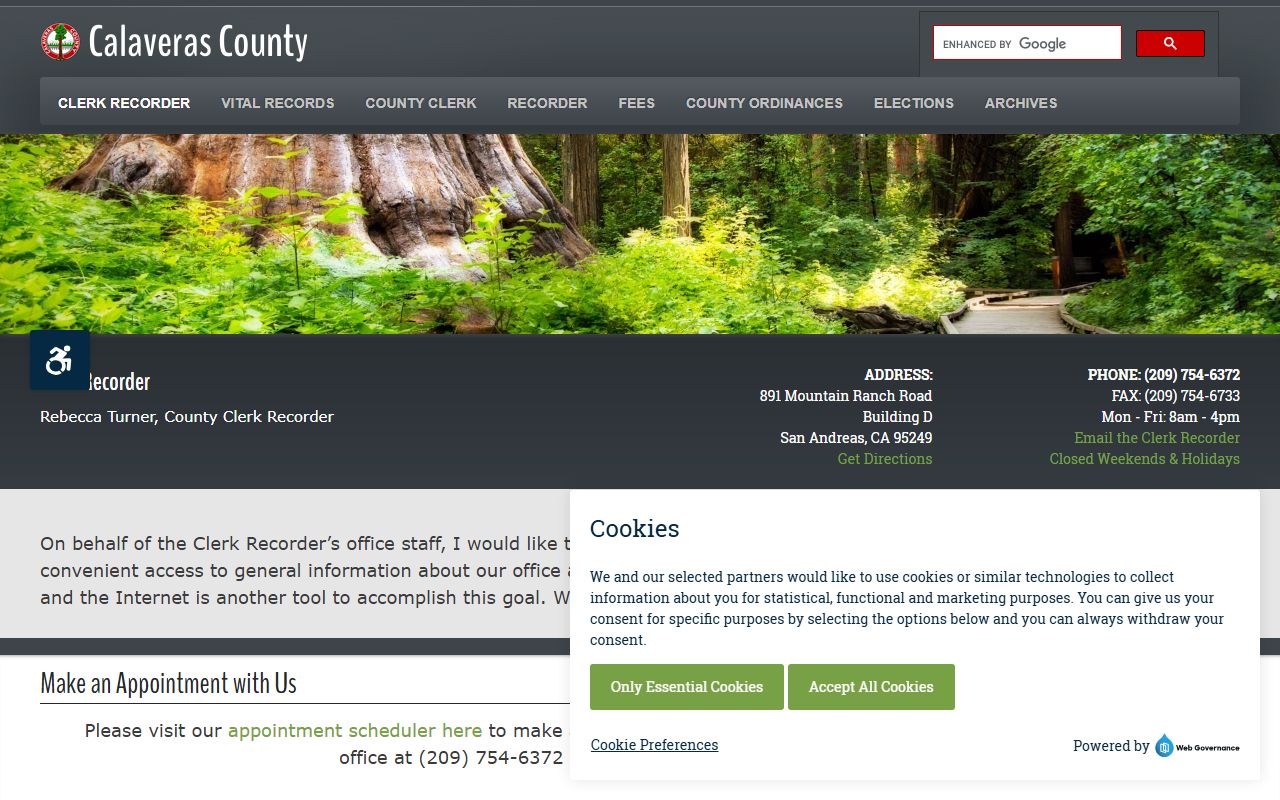
The county website provides contact details, office hours, and instructions for requesting death certificates and other vital records.
Ways to Request Certificates
Three methods exist for getting death certificates from Calaveras County. Go to the San Andreas office in person. Send a mail request with application and check. Or use VitalChek for online orders.
Walk in requests give the fastest service. Bring your government issued photo ID like a driver license or passport. Ask for a death certificate application at the counter. Fill in the deceased person's full name, date of death, and place of death in Calaveras County. Include any other details you know such as age, spouse name, or parents' names. This extra info helps staff locate the correct record.
Pay the $26 fee by cash, check, or money order made out to Calaveras County. Staff will search their system and produce a certified copy if they find the record. Simple requests often get completed while you wait. Complicated searches or very old records may take a few days.
Mail requests need the same information but you send it by post. Download the death certificate application from the county website or request one by phone. Complete every section legibly. Make a photocopy of your ID front and back. Write a check or money order for $26. Put the application, ID copy, and payment in an envelope. Mail to the Clerk-Recorder office in San Andreas. Include your return mailing address. Allow two to four weeks total for processing and mail time.
VitalChek operates California's online vital records ordering system. Visit their website and select Calaveras County. Enter the deceased person's details. Upload ID documents. Pay by credit card. VitalChek charges the $26 state fee plus their own service fees for processing and shipping. Orders typically process in one to three weeks depending on county workload and your shipping choice.
Authorized Copy Requirements
Not everyone can get a full certified copy of death records. California law divides death certificates into two types. Authorized copies go to qualified family and legal representatives. Informational copies are available to the general public but have limited uses.
To qualify for an authorized copy, you must have a close relationship or legal connection to the deceased. Parents, children, grandparents, grandchildren, siblings, spouses, and registered domestic partners all qualify. Attorneys representing the dead person or their estate can get copies. Anyone appointed by a court to manage the estate has access. Funeral establishments handling the arrangements qualify. Law enforcement and government officials conducting official duties may request records too.
Authorized copy requests require a notarized sworn statement. You must sign a declaration under penalty of perjury stating your relationship and legal right to receive the certificate. Take this statement to a notary public who will verify your identity, watch you sign, and apply their official seal. Most banks, post offices, and government buildings have notaries available. One notarized statement can cover multiple certificate requests.
Informational copies do not need a notarized statement. Anyone can request them by simply filling out the application and paying the fee. These copies contain the same data as authorized copies but display a legend across the front stating they cannot be used to establish identity. People use informational copies for genealogy research, family trees, and historical records. They do not work for legal purposes like settling estates or claiming life insurance benefits.
California State Death Records
The California Department of Public Health Vital Records division maintains death certificates for the entire state. Their archive begins in July 1905 when California started centralized vital records collection. Any Calaveras County death registered since 1905 should exist in the state database.
You can request Calaveras County death records from CDPH instead of the county. The state charges the same $26 fee. One advantage of using the state office is their statewide index. You do not need to know which county the death occurred in. This helps when information is incomplete or uncertain.
Contact CDPH Vital Records at P.O. Box 997410, Sacramento, CA 95899-7410. Phone 916-445-2684 for questions Monday through Friday 8 AM to 4 PM. They accept mail orders using form VS 112. They also partner with VitalChek for online requests. State processing times usually run longer than county offices because they handle requests from all 58 California counties.
Deaths before July 1905 are not in the state system. For these old records, contact the Calaveras County Clerk-Recorder directly. Very old records may be incomplete or missing. The California State Archives has some 19th century county records on microfilm but coverage varies.
Nearby Counties
Calaveras County borders several other California counties in the Sierra Nevada foothills and mountains. San Joaquin County lies to the west. Amador County forms the northern boundary. Alpine County and Tuolumne County border to the east. Stanislaus County sits to the south.
Each county maintains its own death records and has its own office procedures. The $26 fee is standard statewide but processing times and office hours differ. Always verify which county the death occurred in before submitting a request. Deaths near county borders sometimes get misattributed.
When Records Are Available
New death certificates take time to enter the system. After someone dies, medical professionals and funeral directors must complete and file the death certificate with the county. California law requires filing within eight calendar days of death under Health and Safety Code Section 102775. The county then reviews, indexes, and processes the record.
Most death certificates become available approximately two weeks after the date of death. For very recent deaths, call the Clerk-Recorder office before submitting a request. Staff can check their system and tell you if the record is ready yet.
Some deaths take longer to process. If a coroner or medical examiner must investigate, the certificate gets delayed until they complete their work and sign off. Complex cases involving autopsies or legal questions may take weeks or months before the final certificate is filed.